


Flowing Tensions: The Geopolitics of India’s Water Treaties and Strategic Pathways by Maj Gen AK Chaturvedi, AVSM, VSM (Retd)

Abstract:
Water is necessary for sustenance of life but it is finite. With ever increasing population it is becoming scarce. There is a need to conserve it, address the reasons which cause frittering of this precious resource. Geography of South Asia is such that its water borne resources are monolithic but political divisions and differing perceptions wrt needs availability and method of sharing has created problems among the countries of the region. To further accentuate there are reasons achieving cooperation to optimally share the resources is further compounding the problem. There are certain international frameworks for sharing of water between riparian states but even those are not being able to help. In this paper an attempt is being made to analyse the problem in totality.
Introduction
Water is a critical natural resource for humankind and the future of our planet. Although water is our largest natural resource, it’s both finite and irreplaceable. The Earth contains approximately 1,386,000,000 cubic kilometers of water, but most of it is saltwater in the oceans. Only about 2.5% of it is freshwater, and the majority of that is locked in ice caps and glaciers or found in deep groundwater. A tiny fraction, around 0.5%or less of the total, is readily accessible for human use in lakes, rivers, and streams[i]. Water sustainability refers to continued availability of clean water for consumption, agricultural processes and bio-diversity. It is vital for the future well-being of humans, and socio-economic development. All living organisms require water, which acts as a fundamental building block for cells and supports a wide range of biological processes. However, water supply is facing a distinct number of challenges. The agricultural industry is currently the largest consumer of freshwater due to its immense need for irrigation, as well as for livestock. As far as sourcing of water is concerned, about 70 percent of the water comes from rivers and groundwater. About a third of the world’s population already deals with water stress, or limited access to clean water and in a few years, it is believed that this number will increase to two-thirds of the world population. In real terms this figure works out to be over a billion currently who are affected by water scarcity, water stress, or other unsafe water delivery conditions. Worst affected areas currently are southern and eastern Africa. In Asia India, China, Bangladesh and Pakistan are experiencing record low amounts of groundwater. In India The average stage of groundwater extraction for the country as a whole works out to be about 60.08%. Here it is interesting to note that anything above 70% is considered critical. Over extraction of ground water has resulted into nearly 409 districts suffering from fluoride contamination and parts of 209 districts have arsenic contamination[ii]. In Bangladesh out of 64 districts 59 suffer from ground water contamination[iii], and Pakistan ranks fourth globally among the arsenic-affected countries[iv]. This flags the criticality of surface water which needs better storage facilities, conservation and better international cooperation among the neighboiurs.
Causes for Demand Supply Gap
Some of the areas which are of relevance in this regard are as follows: –
- Rise in Population- In 1941 India’s population was 389 million[v] and in 2011[vi] India alone was 1210 million. As on date the population of South Asia is around two billion[vii]. No wonder per capita water availability which in 1947 was over 6,000 cubic meters per year for India, has come down in 2025 to 1,341[viii], in Pakistan it is now less than 1000 cubic metres per person per year[ix](which makes it a water scarce country), Bangladesh may not be deficient of surface water (7568 cubic metres per person per year) but her problem is that of geographical and seasonal imbalance.
- Water Waste-, Wastage of potable water reduces overall availability of water. Use of fresh water for modern amenities like flushing of toilets, arboriculture and many such practices need to be addressed to reduce demand.
- Insufficient/ inefficient Infrastructure- Aging pipes and public apathy leads to leakage of billions of gallons of water. In India it is estimated to be as high as 50%[x]. Situation could be worse in other neighbouring countries.
- Food Production- It is increasingly becoming water intensive due to change in the cropping pattern and some of those crops being water intensive. A food for thought: will it not be advisable to enhance the share of coarse grain in the cropping pattern which require less water.
- Pollution- 70 % of the surface water in India is unfit for drinking due to pollution and 163 million people lack access to safe drinking water[xi], in Pakistan only 25.61% people have access to safe drinking water[xii] and in Bangladesh situation is little better as this figure is 47.9%[xiii] .
- Climate Change- It is essentially disrupting the rain cycle and its pattern (first is impacting agriculture and second is resulting into cloud bursts followed by long periods of no rain which impacts recharging of water table), causing faster melting of glaciers. According to the World Glacier Monitoring Service (WGMS), ice losses in the past three years have each been greater than the average of the last full decade (2010-2019), which had the largest average loss of any decade back to 1950. Glaciers under consideration have experienced ice losses equivalent to roughly 4 feet of ice off each glacier in the network each year[xiv]. The irregularity of the rain cycle could be mitigated by having adequate storage capacity, however, India has only 325.455 billion cubic meters (BCM) storage capacity, Pakistan has approximately 16.65 BCM storage capacity and Bangladesh has only 7BCM Capacity. This results into loss of almost 90% of rainwater which could have been used for its people. In Bangladesh at least 81 of the 1,415 rivers have either perished or are on the brink of extinction due to poor watershed management[xv].
Geography of South Asia
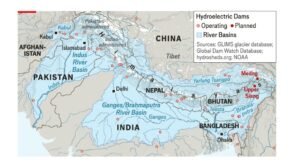 Map-1 Source : As mentioned in the Map
South Asia was earlier referred as the Indian Subcontinent and over a period of time political partitions have resulted into it getting transformed into South Asia which comprises of a number of sovereign countries. However, political divisions have failed to divide the natural resources, particularly rivers which are monolithic. Here it also needs to be noted that Tibet which has now been annexed by China is also part of South Asia geography. Similarly Afghanistan is also part of the region. As can be seen from the above map that most of the North Indian rivers originate in Tibet/ India and then travel to other countries of the region. Thus either China is upper riparian or India is upper riparian. In cases where China is upper riparian states, India is middle riparian state. Thus logically all countries of the region should share these resources equitably but it is not so. While lower riparian states claim their right but upper riparian states normally are prepared to share only that portion which is surplus to their requirement.
South Asia’s water wars- Some of the existing issues are as follows: –
- In late October 2025, Afghanistan revealed plans to build dams on the Kabul river and its tributary Kunar, rankling Pakistan whose dependence on water from Kabul and its tributaries is quite substantial.
- Bangladesh has a peculiar problem. Most of its water resources which Bangladesh has come from India, even those for which India is middle riparian. In fact there are 54 such rivers[xvi]. Following map which clarify Bangladesh’s vulnerability-
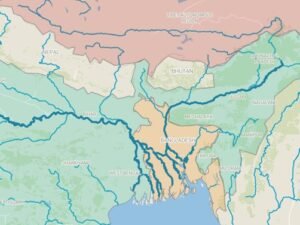 Map-2
Map-2
Ref: OpenStreetMap contributors, The Conversation, CC-BY-ND Created with Datawrapper
In fact Bangaldesh’s problems are many fold. Half of Bangladesh is vulnerable to drought. Around 60% of the population is vulnerable to floods. Around 65 million lack access to safe sanitation[xvii]. To add to their difficulty is its rising population. Climate change and its effects add to her water stress. Bangladesh also complains that India gives no warning when it releases water from existing dams, causing havoc downstream. In Oct 2025, there was a protest in Bangladesh against India’s reluctance to share Teesta waters which is a tributary of Brahmaputra (known as the Jamuna in Bangladesh). The increasing tension with India post change of regime in in Aug 2024 is going to make renewal of Ganges accord due for renewal in 2026 quite difficult. As a pre-emptive step Bangladesh has joined in Jul 2025, UN Convention on the Protection and Use of Transboundary Watercourses and International lakes- 1992[xviii]. To further complicate the situation Bangladesh has proposed in September 2025 to create a new institutional framework to manage water-sharing agreements with India for 14 transboundary rivers. How India is going to respond to this proposal and what would be the effect of Bangladesh having joined UN Convention (which gives her certain legal protection ) on the renewal of Ganges Accord in 2026, wherein Bangladesh is likely to demand higher allocation especially in view of the prevailing state of relations and reducing availability due to climate change is a million dollar question.
- In the month of April 2025 India decided to hold in abeyance Indus Water Treaty (IWT) of 1960 post terrorist attack in Pahalgam. This stoppage has impacted not only agriculture in Pakistan but has also denied latter, information about hydrological changes in the rivers in the Indus River Basin due to floods or stoppages for technical reasons. Pakistan is building a number of dams as part of Northern Arc in Gilgit Baltistan[xix] to reinforce her claim on the region and it has caused consternation in India who considers it as her part and presently under illegal occupation of Pakistan.
- India on her part is worried about a 60 GW hydro electrical project which China is building on Yarlung Tsangpo (Brahmaputra) in Medog County, about 30 Kms from Indian border at a cost $167bn. This project once completed will have major consequences for the downstream neighbours in terms of environmental degradation and its potential of being used as water weapon and above all keeping in view that the area is seismic zone-V[xx].
- Need for energy that too green energy is one of the important reasons for these tensions which may result into conflict if not contained. Hydropower, which does not suffer from the intermittence that ails solar and wind power, is an attractive renewable source. Pakistan already sources a fifth of its electricity from hydropower and aims to up that share. India wants to boost its hydropower capacity of 42GWby more than 50% by 2032, and perhaps build 200 new dams in the next decades. Nepal already produces more electricity from hydropower than it uses. But it continues to build capacity and hopes to export the surplus. It has long supplied electricity to India and has recently started selling power to Bangladesh too, using India’s BBIN[xxi] Here it needs to be noted that the hydro resources are increasingly becoming deficient for the ever increasing demand, as explained earlier.
- Some of the important reasons for not coming to an understanding for equitable sharing are mutual mistrust, perceptual incongruence about the needs of each of these countries, lack of attempts to augment the supply and influence of China on supply as most of the rivers (less Kabul and its tributaries) in the region have their origin in Tibet which is under occupation of China. It may be of interest to note that according to Pacific Institute, a research group in California between 2019 and 2023, there were 191 water-related disputes in South Asia[xxii].
- To India’s consternation, Bangladesh is mulling the idea of forming a trilateral hydro-cooperation with China and Pakistan. This could be part of Bangladesh joining China and Pakistan in announcing a “trilateral cooperation” on the economy, climate and social development.
Trans border River Disputes
This problem is not unique of South Asia but it is actually a global problems. Some of the water disputes[xxiii] are as follows: –
- Nile Basin: The dispute is between Ethiopia; the upper riparian, Egypt the middle riparian and Sudan the lower riparian. Egypt completed the Aswan Dam in 1970. This massive structure provided Egypt with ultimate control over the Nile’s flow, securing its water share unilaterally based on a 1959 agreement with Sudan. Now Ethiopia’s unilateral decision to fill and operate the Grand Ethiopian Renaissance Dam represents a direct attempt to overturn Egypt’s historical control. This state has the potential for a conflict between states.
- Jordan River: Dispute started when Israel (middle riparian) completed a major diversion project, National water Carrier on this river in 1964, on which Jordan a lower riparian also depends. The related issue is of unilateral water diversion of Yarmouk river by Syria (upper riparian)[xxiv]. When the Arab League planned its counter-diversion, it led to cross-border military skirmishes that eventually culminated in the Six-Day Arab-Israel War in 1967. Although an agreement for water sharing was made in 1994 but The basin’s crisis is still festering as all the stake holders namely; Israel;, Jordan; Syria; Palestine and Lebanon suffer from shortage of water.
- Tigris and Euphrates: Turkiye initiated the Southeastern Anatolia Project, known as GAP, in the 1980s, established a permanent upstream-downstream water availability asymmetry with Syria and Iraq with attended problems and tensions. This is compounded by Iran by building dams and diversion tunnels on Tigris tributaries. This project of Turkiye is an example of negative effects of a lack of transnational water cooperation and management. The recently built Ilisu Dam on the Tigris by Turkiye has sparked geopolitical tensions with Iraq and Syria, with the latter two countries currently exploring international legal mechanism and diplomatic channels to block the construction of the dam[xxv].
- Kura-Aras Basin: Both the rivers originate in Turkiye. In the South Caucasus, the Aras River forms the borders between Turkiye, Armenia, Iran, and Azerbaijan. Unilateral projects in Türkiye and diversion by Armenia reduce water availability to lower riparian states of Iran and Azerbaijan[xxvi]. This dependency underscores the need for a coordinated regional approach to water management.
- Ganges River: The Farakka Barrage on the Ganges diverts water towards the Hooghly River, significantly reducing the dry-season flow into Bangladesh. Although the Ganges Water Treaty-1996 is in place between India and Bangladesh but water disputes especially with respect to lean season between the two countries persists.
- The Amu Darya and Kabul River Systems: This acute Central Asian hydro political problem is due to unilateral water exploitation by Afghanistan at the expense of lower riparian states. The massive Qosh Tepa Canal project on the Amu Darya is designed to divert 17-20 % of the river’s flow to irrigate Afghanistan’s northern provinces. This canal poses a direct threat to the established water quotas of lower riparian; Uzbekistan and Turkmenistan. The absence of a basin-wide agreement is resulting into deepening of existing water conflicts. While on issues originating from Afghanistan, another one relates to construction and operation of the Kamal Khan Dam on the Helmand River, which significantly reduces essential water flows into Iran, thus violating the 1973 Helmand River Water Treaty. Yet another dispute is brewing up between Afghanistan and Pakistan because of reported plan for a dam or diversion project on the Kunar River that flows into Pakistan’s Indus system.
- Indus Basin– Indus and five of its tributaries from time immemorial had been irrigating J&K, Punjab and Sind. In Indus River Basin India is middle riparian in case of Indus and Sutlej and China is upper riparian. India is upper riparian in case of Beas, Chenab Ravi and Jhelum. At the time of Indian independence sharing of water became an issue between India and Pakistan. Finally in 1960 Indus water treaty was signed to share the waters of these rivers. Surprisingly China, despite being upper riparian in at least two rivers has not been party to the treaty and similarly Afghanistan who is upper riparian in case of Kabul and some other rivers from West has not been party to the treaty. Despite these flaws the treaty survived various wars between India and Pakistan but finally in April 2025, India, post Pahalgam terrorist attack, decided to hold this treaty in abeyance and exploit water resources of Indus River Basin without referring to Pakistan. This development along with announcement by Afghanistan to build dam across Kunar river which is a major source of water into Kabul and its tributaries which joins Indus at Attock and contribute between 20-28 MAF water to Indus[xxvii] is quite a blow to Pakistan. A question often asked whether Vienna Convention on Law of Treaties (VCLT) is applicable to IWT-1960. To this answer is No! as Pakistan is not a party to VCLT. It also needs to be noted that India has taken Article 60 (1) and Article 62 (1)[xxviii] as ground for holding the treaty in abeyance as otherwise there is no provision in IWT for its abrogation (refer Article XII para-4)[xxix].
- China- After annexation of Tibet, it has assumed the role of Upper Riparian in case of a number of rivers flowing towards South Asia and South East Asia. With no water sharing treaty with any country China is exploiting water resources originating in Tibet with impunity. Latest being under construction Hydroelectric project over Yarlung Tsangpo (which becomes Brahmaputra after entering in India at Pasi ghat) to generate 60 GW of power. The exploitation of water resources originating in Tibet directly impacts countries of South Asia and those countries of South East Asia which are located in the Mekong Basin and Rivers entering Myanmar like Salween and Irrawaddy.
Above description confirms that in case of ‘Trans Border’ water channels the upper riparian states are increasingly weaponizing water resources; both for causing damage to lower riparian states during conflicts and also causing economic hardship and thus render lower riparian states vulnerable to water hegemony of the upper riparian states.
International Conventions wrt Trans Border Water Channels
There are two UN mandated Conventions/ agreements which are there for equitable sharing of waters among the riparian states and a Sustainable Development Goal of UN. These are as follows:-
- UNECE-1992 The Convention on the Protection and Use of Transboundary Watercourses and International Lakes- It was originally meant for Europe and opened for signature at Helsinki and as such is also known as Helsinki Accord, later it was opened for accession to all UN Member States in 2016. It aims to ensure the sustainable use of transboundary water resources by facilitating cooperation. As on date it has 56 members. Latest to become party to it is Bangladesh. This development is likely to strain its water relations with India by pushing for a multilateral approach to water management particularly during the negotiations for the renewal of the Ganges Water Treaty which comes up in 2026.
- Convention on the Law of the Non-navigational Uses of International Watercourses (New York, 1997)- It entered into force on 17 August 2014. It pertains to the uses and conservation of all waters that cross international boundaries, including both surface and groundwater. Aim of this convention is to help conserve and manage water resources for present and future generations. So far it has been ratified by just 36 states. Surprisingly the majority of countries, especially the key ones, remain outside its scope. The convention, however, is regarded as an important step in establishing international law governing water[xxx]. The treaty requires states to take reasonable steps to control damage, caused by Pollution or the introduction of species not native to the watercourse, and imposes an obligation on states that damage a shared water resource to take steps to remedy the damage or to compensate sharing states for the loss. It requires member states to negotiate a mutually acceptable solution, appealing for arbitration as necessary to uninvolved states or international organizations such as the International Court of Justice. Interestingly China as well as none of the South Asian countries have become party to this convention.
- Sustainable Development Goal (SDG) 6- declares the importance of achieving “clean water and sanitation for all”. It is one of the 17 Sustainable Development Goals established by the UNGA. Goal of this SDG is, “To ensure availability and sustainable management of water and sanitation for all.”[xxxi] The goal has eight targets to be achieved by 2030 covering the main areas of water supply and sanitation and sustainable water resource management. All 191 countries are signatory to this SDG. Therefore the implication of it is that none of the upper riparian states can stop the water of lower riparian.
Conclusion
Resources and geography are permanent and if the availability of resources is becoming scarcer due to reasons of rising population, climate change, changing crop pattern and pollution, the problem needs to be tackled at two levels. Firstly, available resources need to be conserved and availability needs to be improved by addressing those factors which are reducing their availability and secondly riparian states need to come to a consensus which is based on demand being addressed on common factors not based on legacy or perceptions. Give and take should be the way to build consensus. All riparian countries need to avoid those hostile acts which are against the interest of other riparian state. There is no doubt that both Ganges Accord -1996 and IWT- 1960 were manifestation of India’s spirit of supporting her neighbours but unfortunately both these countries continued with their hostile acts. Pakistan is now suffering post India having decided to hold the treaty in abeyance and if Bangladesh does not decide to revisit her current policy of trying to cause damage to Indian interests it will suffer the same fate next year when Ganges Accord comes for review. India on her part is continuing to share water within the limit of SDG-6.
Bibliography
- https://healingwaters.org/how-does-population-growth-affect-water-scarcity/
- https://www.iipa.org.in/publication/public/uploads/article/24371700119757.pdf#:~:text=The%20per%20capita%20water%20availability%20has%20declined,approximately%201545%20m3%20per%20annum%20in%202011.Author –
 Maj Gen AK Chaturvedi, AVSM, VSM (Retd) is a retired Indian Army General Officer who has served in Jammu & Kashmir, NE, Andman Nikobar on various appointments at Command and Army HQs. He is Chairman of Think Tank, “STRIVE India”, after retirement is pursuing his favorite hobby of writing for newspapers, journals, and think tanks.Disclaimer: The views expressed are those of the author and do not necessarily represent the views of the organisation that he belongs to or of the STRIVE India.
[i] Saptarchita Datta a, Iradat Hussain Mafat a, Rajat Saxena Sensitivity analysis of water wastage in Indian households”, pub by Materials Today Proceedings, Vol-77, Part 1, 2023, Pages 111-116 and uploaded on https://www.sciencedirect.com/science/article/abs/pii/S2214785322066585
[ii] https://vajiramandravi.com/current-affairs/status-of-groundwater-in-india/
[iii] https://www.iaea.org/sites/default/files/arseniccontamination.pdf
[iv] https://www.sciencedirect.com/science/chapter/edited-volume/abs/pii/B9780128181720000220
[v] “Census of India – Index of Old Census Reports”. Archived from the original on 6 October 2011. Retrieved 9 April 2011.
[vi] Shaikh, Zeeshan (15 June 2015). “Why activists are upset with Census disability numbers”. The Indian Express. Archived from the original on 27 March 2019. Retrieved 16 August 2019.
[vii] https://worldpopulationreview.com/continents/southern-asia#:~:text=Southern%20Asia%20Overview-,Most%20Populous%20Countries%20in%20Southern%20Asia,255%2C220%2C000
[viii]https://www.iipa.org.in/publication/public/uploads/article/24371700119757.pdf#:~:text=The%20per%20capita%20water%20availability%20has%20declined,approximately%201545%20m3%20per%20annum%20in%202011.
[ix] https://pcrwr.gov.pk/wp-content/uploads/2021/07/Water-Scarcity-in-Pakistan-Issues-and-Options-May-18.pdf
[x] https://www.spml.co.in/post/water-loss-management
[xi] https://siwi.org/latest/water-crisis-india-everything-need-know/
[xii] https://www.sciencedirect.com/science/article/abs/pii/S0160412010002060
[xiii] https://sdgs.un.org/basic-page/bangladesh-24739
[xiv] Rebecca Lindsey, “ Climate change: mountain glaciers” pub by Climate.gov dated 09 May 2025 and uploaded on https://www.climate.gov/news-features/understanding-climate/climate-change-mountain-glaciers#:~:text=A%20global%20analysis%20published%20in,in%20the%20network%20each%20year.
[xv] Pintu Kumar Mahala, “Why Bangladesh’s decision to sign UN Water Convention could heighten tensions in South Asia” pub by Scroll .in dated 07 Nov 2025 and uploaded on https://scroll.in/article/1088281/why-bangladeshs-decision-to-sign-un-water-convention-could-heighten-tensions-in-south-asia
[xvi]https://en.wikipedia.org/wiki/List_of_Bangladesh%E2%80%93India_transboundary_rivers#cite_ref-:1_3-4
[xvii] IBID-XV
[xviii] https://bangladesh.un.org/en/296948-bangladesh-first-south-asian-country-join-un-water-convention-aiming-improve-cross-border#:~:text=Bangladesh%20is%20first%20South%20Asian,cooperation%20%7C%20United%20Nations%20in%20Bangladesh
[xix] https://www.dawn.com/news/1556951/
[xx] Ref: https://www.economist.com/asia/2025/11/06/south-asias-water-wars
[xxi] https://fawolak.org/pdf/Insight_May_15_clean.pdf
[xxii] IBID XX
[xxiii] Ali Tauqeer Sheikh, “Trans Boundary rivers” pub by Dawn dated 06 Nov 2025 and uploaded on https://www.dawn.com/news/1953436
[xxiv] https://climate-diplomacy.org/case-studies/jordan-and-israel-tensions-and-water-cooperation-middle-east
[xxv] Achref Chibani, “ Water Politics in the Tigris-Euphrates Basin” pub by Arab Center Washington DC dated 30 May 2023 and uploaded on https://arabcenterdc.org/resource/water-politics-in-the-tigris-euphrates-basin/
[xxvi] https://hagueresearch.org/water-insecurity-in-the-south-caucasus-the-case-of-the-aras-river-and-its-challenges/#:~:text=One%20of%20the%20most%20pressing,Aras%20is%20facing%20severe%20pollution.
[xxvii] https://dialogue.earth/en/uncategorized/kabul-river-basin/
[xxviii] https://legal.un.org/ilc/texts/instruments/english/conventions/1_1_1969.pdf
[xxix] https://treaties.un.org/doc/Publication/UNTs/Volume%20419/volume-419-I-6032-English.pdf
[xxx] Raj, Krishna; Salman, Salman M.A., “International Groundwater Law and the World Bank Policy for Projects on Transboundary Groundwater”, pub as part of Groundwater: Legal and Policy Perspectives : Proceedings of a World Bank Seminar. World Bank Publications. p. 173 during 1999.
[xxxi] Goal 6: Clean water and sanitation”. UNDP. Retrieved 28 September 2015.