


India’s Nuclear Moment: Leveraging Thorium and Global Uranium Ties Under a New Legal Framework By Maj Gen AK Chaturvedi, AVSM, VSM (Retd)

Abstract:
Energy is essential for growth and ideally its availability should be based on indigenous resources. Any other option is fraught with danger of rendering the country vulnerable to adverse geopolitical pressures. A country of the size of India needs to exploit all her energy bearing resources with technologies which are home grown as far as possible. Exploitation of Nuclear energy, which is clean, is an important element in India’s energy security matrix as India has adequate resource in terms of Thorium and now validated technology for its efficient conversion. Efforts, however, need to continue to achieve miniaturization, better efficiency and faster fabrication without compromising safety aspects.
Keywords: PFBR, fissile and fertile material, breeding and reactors.
A New Dawn
In a landmark achievement for India’s nuclear energy programme, the 500 MWe Prototype Fast Breeder Reactor (PFBR) successfully attained criticality on 6th April 2026 at 08:25 PM. It was a quantum leap in the exploitation of nuclear energy for power generation. With this progression India graduated to second stage of India’s Three stage nuclear programme as enunciated by Dr Homi Jehnagir Bhabha in 1954, using indigenous nuclear technology capabilities. It is a matter of satisfaction that it met all the stipulations of the Atomic Energy Regulatory Board (AERB), which had issued clearance after a rigorous review of safety of the plant systems. Fast breeder Reactor (FBR) technology forms the vital bridge between the current fleet of pressurized heavy water reactors (PHWR) and the future deployment of thorium-based reactors, leveraging the country’s abundant thorium resources for long-term clean energy generation. In terms of details of the plant; the technology development & design of PFBR was indigenously done by Indira Gandhi Centre for Atomic Research (IGCAR), an R&D Centre of the Department of Atomic Energy (DAE), and was built & commissioned by Bharatiya Nabhikiya Vidyut Nigam Ltd (BHAVINI), a PSU under the DAE.
FBR are a cornerstone of India’s long-term nuclear strategy. In these reactors Uranium-Plutonium Mixed Oxide (MOX) is used as a fuel. The core of PFBR is surrounded by a blanket of Uranium-238. Fast neutrons convert fertile Uranium-238 into fissile Plutonium-239, enabling the reactor to produce more fuel than it consumes. The reactor is designed to eventually use Thorium-232 in the blanket. Through transmutation, Thorium-232 will be converted into Uranium-233, which will fuel the third stage of India’s nuclear power programme.
This unique capability significantly enhances the utilization of nuclear fuel resources and enables the country to extract far greater energy from its limited uranium reserves while also preparing for large-scale use of thorium in future. Beyond energy generation, the FBR programme strengthens strategic capabilities in nuclear fuel cycle technologies, advanced materials, reactor physics and large-scale engineering. The knowledge and infrastructure developed through this programme will support future reactor designs and next-generation nuclear technologies. As India continues to expand its clean energy portfolio, fast breeder reactors will play a crucial role in delivering reliable, low-carbon, base-load power with higher thermal efficiency. Thus, the attainment of first criticality represents not only a technological milestone but also a major step towards a sustainable and self-reliant energy future for Viksit Bharat.
The reactor incorporates advanced safety systems, high-temperature liquid sodium coolant technology and a closed fuel cycle approach that enables recycling of nuclear materials, thereby improving sustainability and reducing waste.
Introduction
Energy is the driver for the growth of any society and energy security means uninterrupted availability of energy at affordable cost. India, suffers from what can be referred as TQQ syndrome. Energy needs of Indian industry are met through oil and gas and increasingly transiting to renewable which essentially means solar. The current crisis of logistic chain disruption from middle east (M-E) has impacted India because firstly the rates of crude and gas in the international market have gone through the roof, and secondly India is world’s third largest importer of crude oil, the fourth largest consumer of LNG, second largest consumer of LPG. Approximately 45% of India’s crude oil, 60% of natural gas, and over 90 percent of LPG imports originate from the M-E. Also India depends on import for solar cells substantially, though India has built a solar module manufacturing capacity of nearly 200 GW annually. However, its solar cell manufacturing capacity is only around 30 GW. The rising import bill has led India to go for electric vehicles, but Lithium is central to India’s energy transition as it powers lithium-ion batteries used in electric vehicles, grid-scale storage systems and renewable energy integration. However, India is entirely import-dependent for lithium, with supplies concentrated among a limited set of countries and subject to price volatility and global market shifts. This kind of excessive import dependence in the domain of energy conversion has resulted into INR becoming weak and India getting, over taken by Britain and Japan in terms of GDP. Thus there is need to exploit the indigenous resources through indigenous technologies and innovative systems which can help india to achieve not only ‘Energy Security’ but aim for ‘Energy Independence’.
Advantage of nuclear energy lies in the fact that, firstly; India’s nuclear energy programme is substantially indigenous especially as far as stage-1 of the three stage programme is concerned and secondly; conversion of nuclear energy is environmentally free from pollution. There are challenges in terms of capital cost of construction, its gestation period, availability of fuel which is a captive of Nuclear supplier group countries and restrictions imposed by the provisions of the Non Proliferation Treaty- 1968 on a country like India which has not signed the treaty.
However, over a period of time India has been able to sort out the issues of technology and also that of fuel supply. Post first nuclear test by India in 1974, Western countries which were the source of technology to India denied it as a part a coercive policy to force India to sign NPT but India did not succumb to their pressure and over the period of time developed her own PHWR Technology for the exploitation of indigenous low grade uranium to produce energy in a restricted manner because of the limited availability of the indigenous uranium, but after the signing of 123 agreement in 2008, finally nuclear fuel supply normalised. Today NPCIL is operating 24 commercial nuclear power reactors with an installed capacity of 8780 MW. The reactor fleet comprises of two Boiling Water Reactors (BWRs), 20 Pressurised Heavy Water Reactors (PHWRs) (excluding RAPS-1) and two VVER (Light water) reactors of 1000 MW capacity each. NPCIL has 7 more reactors under construction with a total capacity of 6800 MW. With the vision of producing about 100 GW of power using nuclear energy by 2047 the requirement of Uranium is likely to rise many folds. India currently consumes about 1,500–2,000 tonnes of uranium each year. In 2025, the country’s requirement was about 1,884 tonnes. With the expansion of nuclear power, annual uranium demand is likely to rise to about 5,400 tonnes. It is however to be noted that India imports about 70% of its requirement of Uranium, mainly from Canada, Kazakhstan, Uzbekistan and Russia because The Indian uranium is of low grade having concentration ranging between 0.02 and 0.45%, as against the global average of 1–2 %. Because of the poor ore quality, extracting uranium in India is more expensive than importing it. However, relevance of indigenous Uranium remains as it is used for India’s nuclear weapon programme, which is not under IAEA safeguards. Major deposits in India are located in Jharkhand (26%), Andhra Pradesh and Telangana (49%), Meghalaya (9%) and remaining in other states. The total Uranium ore in India is estimated to be 4.3 Lac tons. In view of the limited availability and lower quality of indigenous Uranium, india is likely to remain vulnerable to geopolitical pressures as is being experienced now in case of oil and gas, due to geopolitical uncertainties in future too. Therefore India needs to look beyond Uranium as far as nuclear energy route to strengthen energy security of the country is concerned. This makes graduation to ‘Stage-2’ of ‘Three Stage Nuclear Programme’ at the earliest.
Efforts Being Taken for Nuclear Energy Conversion
A number of steps are being taken to achieve resource and effort optimization in pursuit to enhance contribution of nuclear energy in the energy basket of India. Important steps are as follows:-
- Establishment of New Nuclear Power Plants– These are based on uranium based technology and include those which are under construction/ under planning:-
Table-1
| Ser No | Place | Type | Capacity | Remark | |
| Under Construction | |||||
| a. | Kudankulam, Tamil Nadu
( KKNPP Unit:3-6), |
Light Water Reactor | 4X1000 MW |
ii. Overall India is collaborating with 18 countries |
|
| b. | Rawatbhata Rajasthan (RAPS 7&8) | PHWR | 2X700 MW | ||
| c. | Gorakhpur Haryana (GHAVP Unit 1-2) | -do- | 2X700 MW= 1400 MW | ||
| d. | Total: | 6800 MW | |||
| Sanctioned and Under Planning | |||||
| 10 Plants of 700 MW Capacity at Gorakhpur, Kaiga, Chutka and Mahi Banswara | –do– | 7000MW | Planned date of completion -2032 | ||
- Exploitation of Indigenous Resource- India holds approximately 25% of the world’s thorium. The country’s total in-situ resources are estimated at 11.93 million tonnes of monazite, which contains roughly 1.07 million tonnes of thorium. The geographical breakdown of this resource consists of; Andhra Pradesh (31%), Tamil Nadu (20%), Odisha (20%), Kerala (16%) , West Bengal & Jharkhand (smaller inland placer deposits). Beach sand of Kerala and Odisha has Monazite sand which has 8-10% of thorium. However, use of thorium as a fuel is more difficult than uranium because it requires breeding, which is not cost effective, as against it global uranium prices remain. However, material sovereignty of thorium tilts balance in its favour.
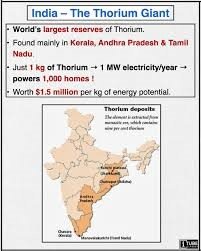 Map-1: Thorium Availability in India
Source: www.instagram.com
- Fast Breeder Test Reactor (FBTR)– Indian endeavour to go for breeder reactor started in 1969, when the DAE entered into a collaboration with the French Atomic Energy Commission, to obtain design of RAPSODIE test reactor and steam generator-based design of PHENIX reactor, which was under-construction at that time. The reactor designs were significantly modified by Indian engineers for the construction of FBTR, designed to produce 40 MW of thermal power and 13.2 MW of electrical power. Also, BARC and IGCAR produced an alternative mixed carbide fuel, which provided even better breeding and thermal properties. Finally, the FBTR attained first criticality in October 1985. It was an indigenously manufactured reactor. After its criticality India joined USA, UK, France, Germany and Erstwhile Soviet Union, in building and operating a breeder reactor.
- Kalpakkam Mini Reactor (KAMINI)– In 1996, an IGCAR made 30 MW research reactor known as KAMINI. It holds the distinction of being the world’s first and the only reactor designed specifically to use uranium-233 fuel, making it a pioneering facility in thorium-based fuel cycle research.
- PFBR– Experience from FBTR operations fed directly into the design of a commercial-scale fast breeding reactor, known as PFBR with the capacity to produce 500 MWe. In 2003 a separate public-sector utility, BHAVINI, to build and operate PFBR and future fast-breeder power reactors, though responsibility for design, R&D, and technical support continued to remain with IGCAR. Construction of PFBR began in 2004. By 2010 IGCAR added new experimental and pilot-scale facilities covering the entire fast-reactor fuel cycle. By 2024, a Compact Reprocessing Facility (CORAL) and a demonstration fast-reactor fuel reprocessing plant were developed to handle high-burn-up FBTR fuel. In 2025, the United States lifted its decades-old restrictions on IGCAR, facilitating energy co-operation between the two nations. Finally PFBR attained criticality on 06 Apr 2026. It is an opportunity to review the direction, Nuclear energy programme of India needs to take. Should India remain committed to graduate to Stage- II or should it pursue a more practical and economical approach based on traditional uranium based technologies? While in shorter run easy availability suggests that India needs to take up less expensive route for nuclear energy exploitation, however, keeping in view of the experience of current geopolitical developments, it would be prudent to identify an optimal path, which entails continue investing in PHWRs/ LWRs as a short to medium term goal and continue working on closed fuel cycle to enhance its efficiency and effectiveness with a view to align its growth with Nation’s mission to achieve ‘Net Zero’ emission by 2070 as a long term goal.
- Small Modular Nuclear Reactors (SMRs)- As defined by IAEA are advanced nuclear reactors that have a power capacity of up to 300 MW(e) per unit, which is about one-third of the generating capacity of traditional nuclear power reactors. These reactors produce a large amount of low-carbon electricity and they are different in the sense that they are physically only a fraction of the size of a conventional nuclear power reactor, their parts are modular in the nature that their systems and components could be factory-assembled and transported as a unit to a location for installation and finally they take the route of nuclear fission to generate heat to produce energy. Given their smaller footprint, SMRs can be sited on locations not suitable for larger nuclear power plants. Prefabricated units of SMRs can be manufactured and then shipped and installed on site, making them more affordable to build than large power reactors, which are often custom designed for a particular location, sometimes leading to construction delays. SMRs offer savings in cost and construction time, and they can be deployed incrementally to match increasing energy demand. Micro reactors (producing up to 10 Mwe) have smaller footprints than other SMRs and will be better suited for regions inaccessible to clean, reliable and affordable energy (In Indian context they will be highly suitable for our border areas). safety concept for SMRs often relies more on passive systems and inherent safety characteristics of the reactor, such as low power and operating pressure. SMRs have reduced fuel requirements. SMRs may require less frequent refuelling, every 3 to 7 years, in comparison to between 1 and 2 years for conventional plants. Some SMRs are designed to operate for up to 30 years without refuelling. As on date more than 80 commercial SMR designs are being developed around the world, targeting various outputs and different applications, such as electricity, hybrid energy systems, heating, water desalinisation and steam for industrial applications. Though SMRs have lower upfront capital cost per unit, their economic competitiveness is still to be proven in practice once they are deployed.
- Indigenous SMRs– The concept design of the Bharat Small Modular Reactor (BSMR)-200MWe is an indigenously developed SMR by a collaborative effort of BARC and NPCIL . It is based on the Pressurised Water Reactor (PWR) technology and has passive and engineered safety features. The BSMR model is slated to utilise Slightly Enriched Uranium (SEU) as fuel. The detailed engineering work for BSMR is underway, with the demonstration unit expected to be erected and started up within six years of financial approval, followed by commissioning and regular operation in the seventh year at an estimated cost of Rs 5,700 crores. It is an example of indigenous development wherein private nuclear vendors are delivering various equipment and components. The SMR-55MWe is also modelled on the PWR technology, featuring a block-type, highly modular design. The lead twin units of the reactor are planned to be set up at the DAE site by 2033. The objective of The SMR-55Mwe, once developed, is to deploy it in remote locations. The system of involving the Indian industry is being planned to be put in place such that the required equipment for the SMR-55Mwe would be produced by the industry. Further, the DAE site plans to build a demonstration plant for a 5 MWth High-Temperature Gas-Cooled Reactor (HTGCR) for hydrogen production. This reactor will be coupled with a suitable copper–chlorine (Cu-Cl) and iodine-sulphur (I-S) processes to generate a 650°C temperature for hydrogen production, which is a clean fuel. These two thermochemical processes have been developed and demonstrated at BARC. Apart from these models, the government is likely to deploy 220 MW Bharat Small Reactors (BSR). India has achieved commercial maturity in indigenous Pressurised Heavy Water Reactor (PHWR) technology, which will serve as a strong foundation to advance the country’s goals for developing and deploying small reactors.
Legal Framework for Involvement of Civilian Industry in India
On 15 December 2025, the Sustainable Harnessing and Advancement of Nuclear Energy for Transforming India (SHANTI) Bill, 2025, was introduced in Parliament, signalling a decisive shift in India’s nuclear energy governance framework. With Presidential assent on 20 December 2025, the SHANTI Bill became an Act of Parliament. It substitutes the Atomic Energy Act (AEA), 1962 and the Civil Liability for Nuclear Damage Act (CLNDA), 2010.
Key Provisions- It broadens the category of entities eligible to apply for a nuclear licence to ‘build, own, operate and decommission nuclear power plants or reactors’, without diluting the Central Government control over all strategically sensitive domains, including fissile material accounting, enrichment, isotopic separation and retain control over sensitive activities such as spent fuel reprocessing and strategic waste management. The involvement of private firms will help mobilise large-scale financial resources, reducing the burden on public finances while accelerating project execution through greater efficiency. It may also contribute to technological innovation by leveraging global partnerships.
Liability Overhaul- The international nuclear liability law, establishes a two-tier compensation mechanism. First, liability is strictly and exclusively channelled to the nuclear operator. Second, if national compensation is insufficient to satisfy all claims for nuclear damage, supplementary compensation is provided through an international fund, contributed by Contracting Parties in accordance with a fixed formula. The CLNDA 2010 had departed from international norms by introducing an expansive right of recourse against suppliers. These provisions created legal uncertainty, discouraged foreign suppliers. The SHANTI Act has aligned India’s nuclear liability regime with established international CSC practice while preserving robust victim compensation through a government-backed mechanism.
Long-Term Mission for Exploitation of Nuclear Energy
The Nuclear Energy Mission (NEM), mention in the Union Budget of 2025–26, set the objective of 100 GW of nuclear power generation capacity by 2047. The mission also supports India’s broader goal of achieving net zero carbon emissions by 2070.
Following measures have been put in place to drive this vision:-
- Financial Commitment: The NEM allocates Rs 20,000 crore towards the design, development, and deployment of SMRs, signalling a serious long-term investment in indigenous nuclear technology.
- SMRs: Operationalisation of at least five indigenously designed SMRs by 2033.
- BARC Initiatives: Development of next-generation reactor designs, including the 200 MWe Bharat Small Modular Reactor (BSMR-200), the 55 MWe SMR-55, and a High-Temperature Gas-Cooled Reactor of up to 5 MWth (Megawatt thermal) designed for hydrogen generation.
- SHANTI Act, 2025: Already enacted.
Conclusion
The NEM is in pursuit of a vision of a energy secure India wherein nuclear energy plays an important part in ultimately achieving energy sovereignty. The attainment of criticality of PFBR is a positive step but a lot more is needed to be done in terms of policy formulation, adequate funding, institutional/ industrial support in terms of research, development and manufacturing to achieve that avowed goal of a self-reliant and energy independent India.
End notes

Author – Maj Gen AK Chaturvedi, AVSM, VSM (Retd) is a retired Indian Army General Officer who has served in Jammu & Kashmir, NE, Andman Nikobar on various appointments at Command and Army HQs. He is Chairman of Think Tank, “STRIVE India”, after retirement is pursuing his favorite hobby of writing for newspapers, journals, and think tanks.
Disclaimer: The views expressed are those of the author and do not necessarily represent the views of the organisation that he belongs to or of the STRIVE India.
Article published Courtsey – Link India Foundation on 29 Jun 2026. https://indiafoundation.in/articles-and-commentaries/indias-nuclear-moment-leveraging-thorium-and-global-uranium-ties-under-a-new-legal-framework/
1 https://dae.gov.in/prototype-fast-breeder-reactor-at-kalpakkam-tamil-nadu-attains-first-criticality/
dated 07 Apr 2026.
2 https://www.iea.org/topics/the-middle-east-and-global-energy-markets
3 Praful Bakshi, “Risk and Resilience: India’s Energy Security in a Volatile Middle East” pub by ORF
New Delhi dated 30 Mar 2026 and uploaded on https://www.orfonline.org/research/risk-and-
resilience-india-s-energy-security-in-a-volatile-middle-east
4 https://www.ndtv.com/business-news/rooftop-solar-panel-june-1-new-rules-india-manufacturing-
higher-price-china-imports-renewable-energy-11573804
5 Puja Das, “India’s critical mineral imports remain highly concentrated, exposing supply risks and
driving diversification push”, pub by Down to earth dated 01 May 2026
6 https://world-nuclear.org/Information-Library/Country-Profiles/Countries-G-N/India
7 https://www.energy.gov/ne/articles/3-reasons-why-nuclear-clean-and-sustainable
8 https://world-nuclear.org/information-library/appendices/india,-china-npt
9 IBID-vi
10 Rakesh Sood, “India and the #NSG: Unfinished business” pub by ORF New Delhi dated 25 Jul 2016
and uploaded on https://www.orfonline.org/research/india-and-the-nsg-unfinished-business
11 https://www.npcil.nic.in/content/328_1_AboutNPCIL.aspx
12 https://vajiramandravi.com/current-affairs/canada-uranium-deal/
13 CK Asnani, “Uranium Mining and Processing in India”, pub by BARC and uploaded on
barc.gov.in/eBooks/9789356590526/paper04.pdf
14 https://www.power-technology.com/news/india-18-nuclear-reactors-2032/?cf-view dated 26 Feb
2024
15 https://www.pib.gov.in/PressReleasePage.aspx?PRID=2238892&reg=3&lang=1#:~:text=Kerala%2C
%20Tamil%20Nadu%2C%20Odisha%2C%20Andhra,West%20Bengal%20and%20Tamil%20Nadu.
16 https://www.barc.gov.in/randd/tfc.html
17 Kale, R. D., "India's fast reactor programme – A review and critical assessment", pub in Progress
in Nuclear Energy dated 01 April 2020 and available on
https://www.sciencedirect.com/science/article/abs/pii/S0149197020300251
18 "IGC newsletter" (PDF), volume 62 October 2004 and uploaded on
http://www.igcar.ernet.in/lis/nl62/igc62.pdf
19 IGC Newsletter, Vol 69 dated Jul 2006 and available on https://www.igcar.gov.in/newsletter/igc69.pdf
20 IGC Newsletter, Vol 61 dated Jul 2004 and available on https://www.igcar.gov.in/newsletter/igc61.pdf
21 S Usha et al, “Research reactor KAMINI”, pub Science Direct Vol 236 Issues 7-8, pp 872-880 dated
Apr 2006 and available on https://www.sciencedirect.com/science/article/abs/pii/S0029549306000823
22 https://www.indiascienceandtechnology.gov.in/organisations/ministry-and-departments/department-
atomic-energy-dae-govt-india/bharatiya-nabhikiya-vidyut-nigam-ltd-bhavini
23 IBID-xx
24 A The Economic Times Report, "US lifts decades-old restrictions on BARC, IGCAR and Indian
Rare Earths in diplomatic breakthrough with India", dated 15 January 2025. Available on
https://economictimes.indiatimes.com/news/economy/foreign-trade/us-lifts- restrictions-on-barc-igcar-
and-indian-rare-earths-in-diplomatic-breakthrough-with-decades- old-
india/articleshow/117272765.cms?from=mdr
25 Prateek Tripathi, “India’s PFBR Achieves Criticality: Implications for India’s Nuclear Future”, as an
Expert Speech, during the Raisina Debates organised by ORF and pub on 30 Apr 2026.
26 https://www.iaea.org/newscenter/news/what-are-small-modular-reactors-smrs
27 Niranjan Chandrashekhar Oak, “Small Modular Reactors and India: Institutional Drivers and
Challenges”, pub by MPIDSA as an Issue Brief dated 19 Sep 2025
28 [3] “Lok Sabha Unstarred Question No – 2264”, Department of Atomic Energy, Government of India,
12 March 2025.
29 “Parliament Question: Progress of the Bharat Small Modular Reactor”, Press Information Bureau,
Department of Atomic Energy, Government of India, 3 April 2025.
30 [5] “Lok Sabha Unstarred Question No – 2264”, no. 3.
31 IBID-xxix
32 Niranjan Chandrashekhar Oak, “SHANTI Act and India’s Nuclear Energy Governance Framework”,
pub by MPIDSA dated 17 Feb 2026
33 [1] “President Draupadi Murmu Grants Assent to SHANTI Bill Passed by Parliament During Winter
Session”, News on Air, 22 December 2025.
34 Chapter II of the Act pp-7 to 9
35 [12] “Convention on Supplementary Compensation for Nuclear Damage”, Information Circular, IAEA,
dated 22 July 1998.
36 “Convention on Supplementary Compensation for Nuclear Damage”, Information Circular, IAEA,
22 July 1998.
37 https://www.pib.gov.in/FactsheetDetails.aspx?id=150617&NoteId=150617&ModuleId=16&reg=3&lan
g=1