


Nepal an Important Strategic and Indispensable Partner

When trust anchors policy and sovereignty is mutually respected,
the Himalayas become not a barrier, but a shared shield of stability
 |
Introduction
1. Nepal is a country sandwiched between India and China. Although, not a rich country, but can be termed as a low-income developing economy. Due to its geographical position, it remains in a highly vulnerable situation which can be exploited by external powers which may be detrimental to India’s interest. Nepal has been facing persistent structural constraints due |
to its landlocked geography, limited industrial base, political instability and governance gaps. Despite the constraints Nepal with a strong will and determination has made notable gains in primary education, health sector and poverty reduction in the last two decades. India and Nepal engage not as distant neighbours but as inheritors of a common civilisational space. Their relationship is a strategic continuum shaped by history, geography and a mature balance of sovereignty, security, and civilisational affinity. Given the deep historical, religious and social links between India and Nepal, India has always remained in a unique situation to help Nepal overcome crises of any sort.
Fact Sheet
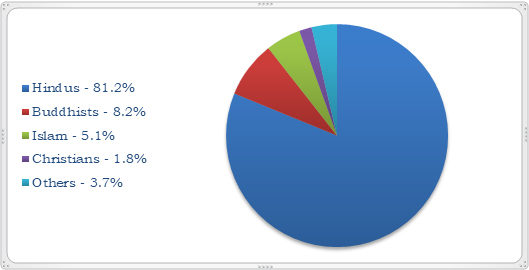
- Nepal has an area of 1,47,31 square kilometres. The Himalayan Country shares 1,751 kilometres of Her borders with India and 1,415 kilometres with China. As per the 2021 census and 2024 estimate, the population of Nepal stands at 29.65 million. The demographic percentages are as under:-
- Due to the open border and lack of official monitoring, the number of Nepalese settled in India varies widely with estimates suggesting figures like 3-4 million Nepali citizens in India. Due to this deep cultural bonding, there are approximately 2.9 million people in India who speak Nepali as a mother tongue (2011 Census). Millions more Nepali citizens live and work in India. There are roughly 1,25,000 to 1,30,000 Indian Army ex-servicemen and their dependents receiving pensions in Nepal. These factors not only strengthen the bond between the two countries but also highlight strong ties between the two neighbouring countries. It is a unique equilibrium that is essential for stability in the Himalayan region.
Handles of Bonding
- Ancient and Cultural Ties. India and Nepal share deep historical, cultural, religious, linguistic, and people-to-people ties that extend back centuries — far before modern nation-states existed. Communities on both sides of the border share ethnic links, festivals, and religious traditions, especially Hindu and Buddhist heritage.
- Treaties and Boundaries. Post the Anglo-Nepalese war, the Sugauli Treaty of 1816 between Nepal and the British Raj basically fixed the present India–Nepal border (approx. 1,751 km). Then in 1923 Nepal–Britain Treaty formally recognized Nepal’s sovereignty on the world stage. Later, post-independence, the 1950 Indo-Nepal Treaty of Peace and Friendship was signed on 31 July 1950. This treaty gave free movement of people and goods, reciprocal residence and property rights, and a commitment to mutual cooperation on security and foreign policy. It became the foundation of modern India–Nepal ties but has also been debated and questioned in later decades. Post 1950, cooperation between the two countries steadily grew with India becoming Nepal’s major economic partner, Nepal’s largest trade partner and investor. As a parallel partner, India has also been assisting Nepal in infrastructure development, health, education, and disaster relief. Over the years, cooperation expanded to treaties like the Mahakali Treaty (1996) for integrated water resources development, especially for irrigation and hydropower.
- Relationship in Recent Years. Economic integration between the two countries has remained strong: India accounts for the majority of Nepal’s trade and investment. Indian firms operate in banking, telecom, power, and manufacturing sectors in Nepal. Infrastructure cooperation between India and Nepal has deepened with initiatives like the India–Nepal Railway Connectivity Project aimed at boosting trade and people-to-people contact. Both countries also engage in institutional dialogues on trade, customs cooperation, and combating unauthorized trade. Open border between the two Nations remains a strong symbol of friendship, facilitating daily cross-border movement for work, education, pilgrimage, and family ties adding to People-to-People and Cultural Bonds.
Challenges and Changing Geopolitics
- Political Instability. The last year (2025) saw significant political unrest in Nepal, showing strong linkages with Bangladesh. The similarities between the two uprisings led to nationwide protests driven by youth frustrations over corruption, governance, and economic issues, resulting in change of government leadership and heightened uncertainty. Such instability has a severe impact on India which shares a long and porous border with Nepal. It raises concerns over border security, cross-border crime, and refugee inflow.
- Assertion of Strategic Autonomy. Nepal periodically voices the need to review or update the 1950 Peace and Friendship Treaty, on grounds that it no longer reflects modern geopolitical realities. This reflects assertion towards greater strategic autonomy.
- Growing Chinese Footprint. China’s outreach through economic investments and tourism initiatives in Nepal, though not yielding exponential results, are a cause of concern for India who remains attentive to China’s influence, especially given shared strategic interests in South Asia.
- Economic and Security Concerns. Political volatility affects normal trade and infrastructure projects, presenting not only short-term frictions but also opportunities for deeper cooperation. Indian reforms in sectors like enhanced cross-border banking and investment facilitation, aim to strengthen economic integration and institutional resilience.
Current Situation
- Given Nepal’s geographic location which affords to a complex yet resilient relationship, relations between the two countries are rooted in deep historical and cultural bonds and institutionalized via treaties and trade partnerships. They are shaped by economic interdependence and shared geography. These relations face modern geopolitical challenges, including internal instability in Nepal and external influences from China. Being dynamic in nature, they continue evolving through cooperation, dialogue, and efforts to adapt longstanding frameworks to contemporary realities. Some of the current dynamics are as under:-
- Security Cooperation. The open border between the two countries throws shared interest in border security, counter-smuggling, terrorism and maintaining peace remains a priority.
- Economic Synergy and Development. Both countries continue to expand cooperation in trade, investment, hydropower, and infrastructure to promote mutual growth.
- Diplomatic Engagements. Age old, established high-level visits and dialogues reinforce ongoing strategic engagement under India’s, “Neighbourhood First” and “Economic Integration” policies.
- Geopolitics. Nepal is treading cautiously, navigating its foreign policy between India, China, and other global partners — seeking balance between sovereignty and economic opportunity.
Historical Perspective
- The first civilization in Nepal flourished around the 6th Century, but Nepal assumed the approximate dimensions of a modern state in the 18th Century when Prithvi Narayan Shah expanded the Kingdom, with help from India, to include Sikkim. Rivalry between the Gorkha King and the British led to the Anglo – Nepalese war of 1815-16 which led to Treaty of Sugauli under which Nepal ceded Sikkim and practically became a British colony. Full political independence was regained in 1923. Up to 1950, under the Monarchy, real power rested with the Rana Prime Ministers who used Bharadari Sabha or Assy of Lords as a deliberative body, which was more of a rubber stamp.
- In 1947, a Constitutional Reform Committee was appointed which drafted, with help for Indian advisers, the Govt of Nepal Constitution Act 1948. It superficially changed the Rana system and established a legislative body of two houses. The more conservative Ranas perceived this constitution as dangerous and forced the Prime Minister to resign and suspend the constitution. King Tribhuvan, in 1951, overthrew the Rana system, established a new interim govt and an interim constitution, which ratified the end of the authority of PM and reasserted King’s supreme executive, legislative and judicial powers.
- In 1959, a new constitution was adopted which vested executive powers in the King who was advised by a Raj Sabha and a Council of Ministers which was answerable to the parliament. The constitution granted the King vide latitude to nullify the parliamentary system. In Dec 1960, King Mahendra invoked these powers to dissolve the Nepali Congress govt and Panchayat Constitution of 1962 followed declaring political parties illegal and gave King the sole source of authority.
- During this period, Nepal was declared a Hindu Kingdom.
- In 1979 King Birendra conducted a national referendum to determine the future form of govt. People had two choices to select form: a continuation of the Party-less Panchayat System or a Multi Party System. Maximum voters opted for the Panchayat System and the constitution was accordingly amended in Dec 1980. Ten years later in 1990, the Panchayat system was overthrown. The King appointed a Constitution Recommendation Commission to draft a new constitution which was promulgated in Nov 1990 ending over 30 years of absolute monarchy. Nepal became a constitutional monarchy through the most liberal constitution.
- On 01 Jun 2001 crown Prince Dipendra carried out the Royal Massacre killing King Birendra, Queen Aishwarya, and other royalites before himself committing suicide. Crown Prince Dipendra was declared king despite being comatose. Post his death, few days later, his uncle Gyanendra became the king in 2001, but the monarchy’s legitimacy was severely damaged. On assuming power, he dismissed the Sher Bahadur Deuba led Govt, dissolved the parliament, postponed elections and assumed full executive powers. By 2005, the Maoist forces had caused enormous turbulence in the Nepalese society which eventually led to abolition of monarchy in 2006. The Maoist insurgency was at its peak and the political crisis deepened.
- By 2006, mass protests by political parties and civil society (Jan Aandolan) forced King Gyanendra to reinstate Parliament and end direct monarchical rule. This led to the major political parties fleeing to India, coming together and forming the Seven Party Alliance (SPA) which retained 90% seats of the dissolved parliament. On 18 May 2006, the SPA abolished the 240-year-old monarchy and declared Nepal a Federal Democratic Republic. Mr GP Koirala assumed the charge as PM and Mr Ram Baran Yadav became the first President. The parliament assumed total legislative power and gave executive powers to the GoN. Names of many institutions including the Nepal Army were stripped off the ‘Royal’ adjective. Raj Parishad was abolished; activities of the King became subject to parliamentary scrutiny and his property became subject to taxation. In Apr 2007, Constituent Assembly elections were announced
- On 21 Nov 2006 the Comprehensive Peace Agreement (CPA) was signed between the political parties and the Maoists at New Delhi with an aim to bring the Maoists into main stream politics through proper electoral process. All parties, incl the Maoists were directed to hold elections under UN supervision by Jun 2007 and change from unitary to democratic system. On 21 Nov 2007 UN Misson in Nepal (UNMIN) was formed with a mandate to provide technical support to Constitutional Assembly elections and monitoring of the peace This led to Pushpa Kamal Dahal ‘Prachanda’ a former leader of Maoist insurgency, becoming the PM on Aug 2008, heading a coalition government. This marked an end to armed conflict, although political parties kept jostling for power and influence.
- The new constitution was promulgated in 2015 with Nepal adopting a new federal constitution, restructuring the state into provinces and affirming secular republican governance. A state of flux continued between 2015 to 2022 with shifting coalitions and leadership.
- Surprisingly, late 2023 once again saw large scale demonstrations organised by Rashtriya Prajatantra Party and monarchist supporters calling for restoration of monarchy and Hindu state status, reflecting frustration in democratic governance. This was indeed a signal of disillusionment with contemporary politics. This Gen-Zee pro-royalist youth-led mass demonstration erupted nationwide against government corruption, nepotism, and a social-media ban; protests turned violent and demanded accountability and political reform. Protesters stormed the Federal Parliament building. Widespread unrest followed, dozens were killed, and government institutions damaged. The situation was chaotic and similar to what was observed in Bangladesh just a couple of months back.
- PM KP Sharma Oli resigned amid the crisis and Smt Sushila Karki was appointed interim prime minister by 12 Sep 2025. The first female PM had a difficult task at hand — national stabilization and preparation for elections. General elections have now been scheduled for 05 Mar 2026 with emergence of new political formations with different permutation and combinations.
Nature of Gen-Zee Protests
- Meaningful similarities can be drawn between the protests in Bangladesh and Nepal. It could also be inferred that the protests in Nepal in Sep 2025 were motivated by the protests in Bangladesh that happened in Jul 2025. The similarities can be drawn as under:-
- In both cases, protests were driven primarily by young citizens rather than traditional party cadres. In Bangladesh the students and urban youth were protesting against economic crisis, political collapse and shrinking civic space. Nepal Gen-Zee protests were anti-elite and anti-major political parties. Both the protests can be termed as ‘generational revolts against stagnation’.
- Both the protests were non-political and non-ideological. The protesters did not demand for any party or leader, but demanded accountability, institutional reform and space.
- In both cases the matter snowballed because of widespread arrests, use of force and clampdown on communication.
- Since both Bangladesh and Nepal have youth heavy demographics, the protests need a deeper understanding as India too has a youth heavy demography. Both reveal a pattern of political stress in India’s immediate neighbourhood and definitely has direct implications for India’s security, diplomacy, and regional strategy. While Bangladesh faced a challenge to authority, Nepal faced a crisis of legitimacy. Both these are relevant to India where a deep-rooted democratic processes, assertion of freedom of speech and expression are gaining enormous proportions. Demand for fundamental rights is fast growing through social media that is uncontrolled as of now.
Strategic Importance
- The geographical location that Nepal enjoys definitely reduces conventional military threat from China. Instability in the region exists due to inimical neighbours across the Northern and Western borders. With Bangladesh now turning indifferent and hostile, it is essential that Nepal and India engage with each other in a more intense manner to ensure long lasting regional balance. It is important to ensure that Nepal remains stable and friendly so that unwanted activities by China through Nepal are controlled, restricted and monitored. Nepal’s engagement with China is a geographical reality. Given the Chinese expansionist mindset, India needs to follow an inclusive policy by developing strategic reassurance.
Way Ahead
- The way ahead for India-Nepal relations lie in leveraging and converting natural proximity, historical and cultural linkages into a strong and thriving partnership. India needs to ensure that She is Nepal’s most reliable partner by delivering durable and reliable projects on time. We need to engage in institution-based programs rather than governments or personalities. India needs to tread with strategic restraint ensuring Nepal’s sovereignty, culture, trust and ethnicity. Given the turbulent neighbourhood that we exist in, Nepal’s engagement should be aligning towards development, creating a strong partnership and projecting itself as a reliable fall back. While there has been substantial growth of bilateral trade between the two countries ($8.9 billion in financial year 2022-23), it needs to be followed up with increased intensity. Projects that bring prosperity to both the countries like water harnessing, hydro-electric power and surface communication development within and outside of Nepal must be taken forward by both the Nations. Although the economic parity between India and Nepal is quite asymmetric, it is securely embedded in history, culture and established protocols. Institutional linkages, historical treaties, policies and geography are imperatives that will not change with time. Hence, interdependence between the two Nations should be leveraged. The way ahead for India is by ensuring stability in Nepal. The best course is served through soft power, mutual respect, responsibility and institutional engagement.
Conclusion
- The recent unrest in India’s neighbourhood underscores that this is not an isolated Nepali condition. It is a part of wider South Asian pattern where youthful societies are increasingly impatient with political systems that promise transformation and continuity. Nepal’s political journey has been a roller-coaster ride in the last century. The landmark events have been:-
- The royal palace massacre.
- The abolition of monarchy.
- long struggle to institutionalise federal republicanism.
- Recurring cycles of fragile coalition governments.
- Political instability reflecting a state in flux and search of durable legitimacy.
- How Nepal reconciles its democratic aspirations with governance capacity will shape not only its own future, but the strategic equilibrium of the Himalayan region. For India, the imperative is neither intervention nor indifference, but strategic patience: supporting stability rooted in institutions rather than individuals, respecting Nepal’s sovereign choices while remaining attentive to the spillover risks of instability along an open border.
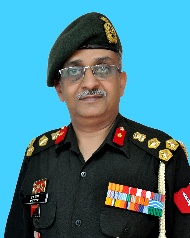 |
Brig Brij Gopal, YSM, SM (Retd) was commissioned into the 10th Battalion of 10 DOGRA Regiment in the year 1986 from Indian Military Academy. He raised 62 Rashtriya Rifles (DOGRA) and has authored a book on his experience of raising an RR Battalion. He is an alumnus of Defence Services Staff College and has done the Higher Command course at Army War College, Mhow |