


Rare Earths In India’s Atma Nirbhar Bharat Campaign By Maj Gen AK Chaturvedi, AVSM, VSM (Retd)

Abstract:
Sustainable availability of Rare Earth Elements (REE) and critical minerals is extremely important for the economic and sustainable growth of the country. However, it is presently a captive of restrictive practices of those who either own them and have technology to process it, or may not be having adequate resources but have technology to mine and process it. China presently has control over 90% of rare earth Elements. This indeed provides her an opportunity to weaponize it to extract undue gains. India, needs to have a strategy to expedite mining to manufacture of these elements for indigenous resources and use diplomatic efforts to have access to these elements for uninterrupted supply of components to fuel her economy with the objective of keeping environmental sustainability intact.
Key words: RRE, CMO, International cooperation, Pax Silica.
Introduction
REEs are a group of 17, largely lustrous silvery-white soft heavy metals; namely Lanthanum, Cerium, Praseodymium, Neodymium, Promethium, Samarium, Europium, Gadolinium, Terbium, Dysprosium, Holmium, Erbium, Thulium, Ytterbium, Lutetium, Scandium, and Yttrium. They are considered “rare” because they are rarely found in quantities that are profitable to mine, and also they are difficult to separate from surrounding materials. REE are to be distinguished from critical minerals as the former ones are technology specific and as such are strategic in nature and rare earth minerals are those which contain one or more rare-earth elements as major metal constituents.
Critical Minerals– The critical minerals in the present context are copper, lithium, nickel, cobalt, and rare earth elements, all essential for the production of low-carbon technologies, such as wind turbines, solar panels, batteries, and electric vehicles. Demand for these minerals is expected to grow significantly as the global community strives to achieve net-zero carbon emissions by 2050. The rise in demand for these and relatively lesser supply make them critical. It may be noted that their availability is restricted to only certain geographies. Developing alternatives to these minerals often requires significant time, investment, and technological advancements. These minerals contribute significantly to SDGs set out by UN, as these minerals lend themselves to developing technologies for the provision of clean water and sanitation (SDG-6), affordable clean energy (SDG-7), Industry, innovation & infrastructure (SDG-9) and responsible consumption & production (SDG-12). Here, it is also critical to note that the mining of these materials is done responsibly to ensure environmental protection, however, keeping in view their criticality, these minerals required to be mined and as such, their, supply chain needs to be given a serious thought. The countries which have maximum of these minerals and state of India is as tabulated below:-
Table-1
| Ser No | Critical Mineral | Percentage of the World Production as in 2024 |
| 1. | Bauxite | Guinea- 28.89
India-5.56 |
| 2. | Chromium | South Africa-44.68
India-8.72 |
| 3. | Cobalt | DR Congo- 75.86
India- Negligible |
| 4. | Copper | Chile-23.04
India-2@ |
| 5. | Graphite | China-79.38
India-1.74 |
| 6. | Lithium | Australia-36.67
India-0#-however certain reserves in Reasi District of J&K and Chhattisgarh have been found. If properly exploited India could move to the group of first 10 countries |
| 7. | Manganese | South Africa-37
India-4 |
| 8. | Molybdenum | China-42.31
India- Negligible. As per NMI database as on 1.4.2020, based on UNFC System, the resources of molybdenum ore in the country have been estimated at 27.20 million tonnes containing about 16,891 tonnes of Molybdenite (principal ore)$ |
| 9. | Nickel | Indonesia-59.46
India- less than 01 |
| 10. | REE | China-69.23
India-0.74 |
| 11. | Silver | Mexico-25
India- India has no major native silver deposits; silver occurs with lead, zinc, copper, and gold ores. Total silver reserves/resources are estimated at 30,267 tonnes.% |
| 12. | Uranium | Kazakhstan-38.58
India-1.1 |
Note–
@– http://mines.nic.in/writereaddata/UploadFile/HCL_PDAC_13.pdf
#- https://evreporter.com/the-global-lithium-race-where-does-india-stand/#:~:text=Needless%20to%20mention%2C%20India%20has,in%20the%20lithium%20value%20chain.
$-https://ibm.gov.in/writereaddata/files/16821553596443a75f5ed4aMolybdenum_2021.pdf
%- https://www.insightsonindia.com/2026/01/21/silver-metal/#:~:text=India%20has%20no%20major%20native,integrated%20smelting%20and%20refining%20capacity.
In the context of REE, the term “rare-earth” is a misnomer because these are not scarce but are found only in compounds and as such are difficult to isolate and purify. Although called “rare earths,” many aren’t especially rare in full crustal abundance. The “rare” part comes from difficulty in economically extracting and separating them in a pure form. Their ores are often low-grade, closely intermixed, and require complex refining. The main ore sources are minerals like bastnasite, monazite, and ion-adsorption clays. The U.S. Geological Survey notes that, by weight, elements like cerium are relatively common (≈60 parts per million), whereas elements like thulium and lutetium may be as scarce as 0.5 ppm. Another issue with them is that they are spread thinly. As such, to obtain rare earths at usable purity, requires processing enormous amounts of raw ore at great expense. Because of their geochemical properties, rare-earth elements are typically dispersed and not often found concentrated. Consequently, economically exploitable ore deposits are sparse. The first rare-earth mineral discovered in 1787CE was gadolinite, a black mineral composed of cerium, yttrium, iron, silicon, and other elements. Commercial production in modern times describes the reserves of the REE in terms of “rare-earth oxides” (REOs). Mining and extracting these elements is often difficult and produces significant toxic and radioactive waste. What gives these elements their outsized importance is not bulk use but unique magnetic, catalytic, and optical properties. However, what makes them useful is their unique magnetic, luminescent, and electrochemical properties. Despite their high relative abundance, rare-earth minerals are more difficult to mine and extract than equivalent sources of transition metals, due in part to their similar chemical properties, making the rare-earth elements relatively expensive. Their industrial use was very limited until efficient separation techniques were developed, such as ion exchange, fractional crystallization, and liquid-liquid extraction in the late 1950s and early 1960s. In today’s world when approach is to go for net zero carbon emission their usage in making of high-performance permanent magnets for electric vehicles and renewable energy, flags their importance. As such, these are crucial for high-tech applications, including smartphones, electric vehicle motors, wind turbines, and defence systems. The demand for REEs has expanded over the years.
Known areas of their utilization is as follows and the detailed usage is as per Table-2: –
- Electronics: Smartphones, computers, and televisions (e.g., europium in screens).
- Green Energy: Neodymium, praseodymium, and dysprosium are essential for wind turbines and electric vehicle motors.
- Defense: Night vision goggles, radar, and missile guidance systems.
- Industrial: Catalysts for petroleum refining, glass polishing, and laser technology.
Table-2: RRE Availability in the World
| Ser No | Name | Selected applications | Abundance Parts Per Million (ppm) in earth’s crust |
| 21 | Scandium | In aerospace components, additive in metal halide/ mercury vapor lamps | 22 |
| 39 | Yttrium | In LASER, television, high temperature superconductors tooth crown, as refractory material in jet engines and coating for engines and industrial gas turbines, fuel cells, ceramic electrolyte, jewellery, cancer treatment and many other. | 33 |
| 57 | Lanthanum | In alkali-resistant glass, flint, hydrogen storage, battery-electrodes, camera, reflective telescope lenses and catalyst for oil refinery | 39 |
| 58 | Cerium | Polishing powder, yellow colours in glass and ceramics, catalyst for self-cleaning ovens, cracking catalyst for oil refineries, for lighters, and coatings for turbine blades[20] | 66.5 |
| 59 | Praseodymium | Rare earth magnets, LASERS, core material for carbon arc lighting, colorant in glasses and enamels, additive in didymium glass used in welding goggles, flint products, single-mode fibre optical amplifiers | 9.2 |
| 60 | Neodymium | Rare-earth magnets, LASERSs, violet colours in glass and ceramics, didymium glass, ceramic capacitors and electric motors in electric automobiles | 41.5 |
| 61 | Promethium | Nuclear batteries, luminous paint | 1×10⁻¹⁵ |
| 62 | Samarium | Rare-earth magnets, LASERs, neutron capture, MASERs, control rods of nuclear reactors | 7.05 |
| 63 | Europium | Red and blue phosphors, LASERs, mercury vapour/ fluorescent lamps, NMR relaxation agent | 2 |
| 64 | Gadolinium | High refractive index glass, LASERs, X-ray Tubes, computer bubble memories, neutron capture, MRI contrast agent, NMR relaxation agent, steel and chromium alloys additive, magnetic refrigeration, positron emission tomography scintillator detectors, a substrate for magneto-optical films, high performance high temperature superconductors, ceramic electrolyte, oxygen detectors, possibly | 6.2 |
| 65 | Terbium | Additive in neodymium based magnets, green phosphors, LASERs, fluorescent lamps, magnetostrictive alloys, naval sonar systems stabilizer of fuel cells | 1.2 |
| 66 | Dysprosium | Additive in neodymium based magnets, LASERs, magnetostrictive alloys , hard disk drives. | 5.2 |
| 67 | Holmium | LASERs, wavelength calibration standards for optical spectrophotometers, magnetic fields, permanent magnets. | 1.3 |
| 68 | Erbium | Infrared LASERs, vanadium steel, fibre optic technology. | 3.5 |
| 69 | Thulium | Portable X-ray machines, metal halide lamps, LASERs. | 0.52 |
| 70 | Ytterbium | Infrared LASERs, chemical reducing agent, decoy flares, stainless steel, strain gauges, nuclear medicine earthquake monitoring. | 3.2 |
| 71 | Lutetium | PET scan detectors, high-refractive-index glass, catalyst used in refineries, LED bulb. | 0.8 |
Economic Scale and Market structure- While the tonnage is modest compared to metals like iron or aluminium, the economic stakes are high. In 2024, the global rare earth elements market was estimated between USD 12.44 billion (IMARC) and roughly similar figures in competing reports, with forecasted growth (CAGR ~12–13 %) through the next decade. Regions like Asia-Pacific already dominate share. Meanwhile, the segment of REEs tied to permanent magnets (Nd, Pr, Dy, Tb) accounts for an outsized share of value — though cerium and lanthanum dominate by volume, the “rare earth permanent magnet (REPM)” materials capture over 96 % of the market value in many analyses.
China probably understood their relevance well before others and no wonder, she controls approximately 60% of mining production and 90% of processing of the world.
RREs in World
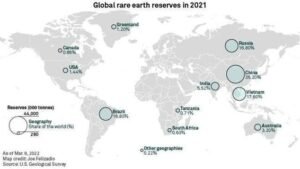 Map-1: Availability of RREs in the World
Source: https://www.reddit.com/r/MapPorn/comments/y2j486/reserves_of_rare_earth_metals_in_the_world_as_of/
Overview of REE Availability in the World– In 1993 38% of World’s production was in China, 33% in USA, 12% in Australia and 5% each in Malysia and India have necessary minerals to extract RREs. Several other countries including Brazil, Canada, South Africa , Sri Lanka and Thailand make up the remainder. As explained earlier China realised the importance of RREs early and as such in 2009 production of RREs in China reached 90% of the World’s production and by 2011 it had reached 97%. No wonder in tariff war US had to back down against China and reduce the tariff from 57% to 47% in Oct 2025 after talks between President Xi Jinping of China and President Donald J Trump of USA.
Importance of Africa for REEs– Due to tectonic plate movements that create favourable conditions for mining, certain areas such as north and southern Africa, as well as the western coast of South America, have concentrated deposits of rare earth minerals. Availability of REEs in Africa, a continent with largely unexploited mineral wealth, makes it vulnerable to geostrategic hedging by industrialised West and China, because control of REEs will give the concerned power an important economic and strategic advantage in the future global geopolitical balances. Here it is significant to note that India is also quietly making an inroad in Africa by helping 55 Nation Africa Union become a permanent member of the G-20 grouping post G-20 summit at Delhi in 2023. For the time being, REE research is concentrated in Namaqualand region, South Africa (Compton et al. 2003). In Mozambique, a large REE deposit, especially for Dysprosium, was discovered on Mount Muambe. Namibia has a mining repository within which REE are located (Bühn et al., 2001). In Tanzania, the Wigu Hill mining depot, 200km west of Dar Es Salam capital, appears to be a major supplier, particularly because of its geological formation that allows the extraction of rare earths elements without resorting to complex, expensive and very polluting processes. Cameroon seems to have a large pool of REEs that remains little known, and from which study can generate significant strategic resources (e.g., Braun et al., 1990, Braun et al., 1998; Ndjigui et al. 2009; Nguetnkam et al., 2014; Etame et al. 2009; Kamgang Kabeyene et al. 2009; Onana et al. 2016; Ngo Bidjeck et al., 2019; Nyeck et al. 2019). Their importance to technology has imbued them with a particular—and increasing—value to the global economy, sparking a modern variant of “resource wars.” Desire for control over these is currently fuelling unrest in Central Africa. Morocco because of its zinc deposits has become an important player in the export of this metal, which is widely used in batteries as well as pharmaceutical products. The presence of valuable minerals in South Africa has contributed to her rise as a diversified economy. Although Zimbabwe is endowed with mineral wealth similarly, but poor governance is limiting her capacity to exploit her mineral resources.
Jockeying for Annexation of Greenland by USA– Trump’s interest in gaining control of Greenland, a substantial hub of rare earth deposits. What is US Interest in Greenland– This he self-governing Danish territory contains large deposits of elements essential for various advanced technologies, particularly those used in electronics, renewable energy, and defence applications.
Ukraine- is also home to a number of critical mineral reserves, including lithium and titanium, a lightweight and corrosion-resistant metal employed in the construction of aircraft, surgical instruments and chemical processing equipment. RRE are also there in Ukraine. The value of Ukraine’s largely untapped deposits has been in the sights of USA. President Trump in an interview to the Fox News last year said that he wanted “the equivalent of $500 billions of rare earth” from Ukraine in return for continued assistance, and that Ukraine had “essentially agreed to do that.” This proposal was presented to Ukrainian officials last week and would allow American companies to hold a 50 percent stake in Ukraine’s rare earth mineral deposits as compensation for both past and future US military support. However, recently, Ukrainian President Volodymyr Zelensky said that his country was not ready to sign any agreement on this, as the proposal “is not ready to protect us, our interest.” President Trump, as has been his style later said that the U.S. and Ukraine were “pretty close to a deal” granting access to its rare earth minerals. In this connection recently, Robert Muggah, a fellow at Princeton University, and Rafal Rohozinski, senior fellow at Canada’s Center for Governance Innovation put in perspective the importance of REEs deposits in Ukraine, that the Ukraine’s mineral resources “are not only pivotal to Ukraine’s sovereignty but also to Europe’s energy independence and the competition between the United States and China for technological dominance. Control over these resources is a decisive if underrated factor in shaping the conflict’s trajectory and will almost certainly influence the contours of its resolution.”
Elephant in the Room: China– China remains the global powerhouse in rare earth elements, holding 44 million metric tons and remaining the world’s leading rare earths producer. Its dominance could potentially intensify America’s push to expand its mineral reserves, given Beijing has in the past boasted about its reserves, considering these a source over leverage given the potential impact of export limitations on global prices. China has weaponised its capability to mine and process REEs. In October 2025, export restrictions on the export of RREs imposed by China, illustrate how China is weaponizing its dominance. New rules require foreign producers that use Chinese equipment or inputs would be required to obtain approval for exports. Magnet makers whose products contain any non-trivial fraction of Chinese RRE must also get a license. China also announced tighter control on to export of technologies tied to chipmaking and magnets- exports involving rare earths tied to memory chips (256+ layers) or logic (14 nm or below) face additional scrutiny. China rationalised these restrictions to her national security and prevention of dual-use technology transfer. It resulted into a standoff over the RRE, which are critical for digital and defence industry world over but US in particular. Initially USA pushed back hard. The U.S. responded with steep tariffs, 100% on some Chines goods but it indeed raised alarms in strategic and defence sectors. The Pentagon has accelerated stockpiling critical minerals (including cobalt, tantalum, scandium) in response to the squeeze. On May 12 2025 , both countries reached a truce in a bid to reduce tensions. The U.S. reduced tariffs on Chinese goods to 30% while China responded by reducing tariffs on U.S. products to 10%. Trump claimed that Xi had agreed to resume rare earth mineral flows to the U.S., and temporary export licenses were granted to some suppliers during a truce. But the underlying structural tensions remain unresolved. The risks are real. U.S. technology and defence sectors could face material shortages, price spikes, and slower innovation. Supply chain disruption might push up costs across consumer electronics, EVs, clean energy, and telecom. Some specific consequences:
- Supply Shock & Inflation: Prices for REE-derived components (magnets, alloys) could spike, disrupting OEM budgets.
- Strategic Vulnerability: Dependence on a rival for critical elements becomes a national security flaw.
- Forced Delays or Design Changes: Engineers may need to redesign systems to use alternative materials or reduce reliance on heavy REEs — a costly and time-consuming shift.
- Export Retaliation & Supply Chain Fractures: The U.S. may retaliate with its own curbs, fragmenting global trade flows further.
PAX Silica an US initiative which has been joined by many of those countries, including India which are affected and remain vulnerable to weaponisation by China of REEs.
What Happens if China Chokes off Rare Earth Exports to the U.S.A.?- This indeed a real possibility and has to be prepared for. Not only US it will impact many other countries including India. Following actions by US/ other stake holders are going on:-
- Global Responses & Diversification Efforts- Countries and companies are exploring alternate supply chains: mining projects in Australia, Greenland, Africa, and the U.S. are advancing. Some new projects track 146 advanced REE developments globally, totalling hundreds of millions of tons of rare earth oxide potential.
- Building of Local Refining and Separation Capacity Asian, European, and African jurisdictions are also pushing for to reduce dependence on Chinese processing.— especially
- Magnet Recycling and Closed-loop Reuse — Circular economy approaches is being resorted to by ramping up recycling. Governments are offering subsidies, stockpiling strategic reserves, and rethinking critical mineral policy frameworks.
- Inside the U.S., Mountain Pass (California) remains a visible REE source, though most of its ore still undergoes separation abroad. Legislations and incentives aim to encourage domestic refining, separation, and magnet-making capabilities to rebuild value chains closer to home.
Pax Silica– This alliance is about backstopping technological leadership with supply chain control. Initially its members besides US were; Japan, South Korea, Australia, Greece, Singapore, UAE, UK, Israel, Qatar and Netherlands. India joined it on 20 Feb 2026. Although literally it means ‘Silica Peace’, however it deals with computing technologies and in no way it refers to peace. In fact it is a manifestation of tech cold war, entailing jockeying for critical minerals. In Apr and Oct 2025 China, who controls these minerals substantially curbed their supply as well as that of permanent magnets made of rare earths. Fall out of such a denial was that US had to backdown from imposition of enhanced tariff on China in Oct 2025. Therefore aim of PAX Silica is to reduce coercive dependencies. India was invited to join the alliance based on her strength of deep talent, engineering depth and critical mineral processing capability. India’s entry into this alliance makes it easier for her investment from the member nations. Although it is true that this alliance may not able to challenge China in the domain of critical minerals, but if 20-30% of the processing capacity comes up outside China, it will substantially degrade Chinese propensity to disrupt supply chains.
India’s Progress in the Field of REE and Critical Minerals
Critical Minerals
Table-3: Import dependence of Critical Minerals in India
| Ser No | Critical Mineral | % Dependence | Source Countries as on 2020 |
| 1. | Lithium | 100 | Chile, Russia, China, Ireland, Belgium |
| 2. | Cobalt | 100 | China, Belgium, Netherlands, Japan, USA |
| 3. | Nickel | 100 | Sweden, China, Indonesia, Philippines, Japan |
| 4. | Vanadium | 100 | Kuwait, Germany, Brazil, Thailand, South Africa |
| 5. | Niobium | 100 | Australia, Indonesia, Brazil, Canada, South Africa |
| 6. | Germanium | 100 | USA, France, South Africa, China, Australia |
| 7. | Rhenium | 100 | Russia, UK, Netherlands, South Africa, China |
| 8. | Beryllium | 100 | Russia, UK, Netherlands, South Africa, China |
| 9. | Tantalum | 100 | Australia, USA, Malaysia, South Africa, Indonesia |
| 10. | Strontium | 100 | China, USA, Russia, Estonia, Slovenia |
| 11. | Zirconium | 80 | Australia, USA, Malaysia, South Africa, Indonesia |
| 12. | Graphite | 50 | China, Madagascar, Mozambique, Tanzania, Vietnam |
| 13. | Manganese | 60 | South Africa, Gabon, Brazil, China, Australia |
| 14. | Chromium | 2.5 | South Africa, Mozambique, Turkey, Oman, Switzerland |
| 15. | Silicon | <1 | China, Bhutan, Netherlands, Norway, Malaysia |
Ref: https://fiia.fi/sv/publikation/indias-critical-minerals-strategy
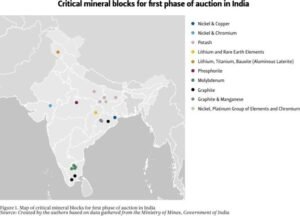 Map-2: Critical Mineral Blocks being Developed
As can be seen in Table-1and 3, India is poorly endowed with Critical minerals and has to depend substantially on import substitution. The strategy adopted by the GoI focuses on boosting domestic exploration, acquiring assets abroad, promoting recycling, and creating a conducive policy environment. Action taken by the GoI in this regard are as follows:-
- The Geological Survey of India (GSI), under the Ministry of Mines, follows the United Nations Framework Classification (UNFC) classification and Minerals (Evidence of Mineral Contents) (MEMC) Rules, 2015, to carry out exploration activities for critical minerals.
- The Government of India launched the National Critical Mineral Mission (NCMM) in 2025, with the objective of to secure India’s critical mineral supply chain by ensuring mineral availability from domestic and foreign sources and strengthening the value chains by enhancing technological, regulatory, and financial ecosystems to foster innovation, skill development, and global competitiveness in mineral exploration, mining, beneficiation, processing, and recycling.
- A committee was formed by the Ministry of Mines in November 2022, which identified 30 critical minerals, with 24 included in Part D of Schedule I of Mines and Minerals Development and Regulation Act, 1957 (MMDR Act, 1957). This means that the Central Government now has the exclusive authority to auction mining leases and composite licenses for these specific minerals.
- The Committee also recommended setting up a Centre of Excellence on Critical Minerals (CECM) to regularly update the mineral list and guide strategy.
- To establish a robust framework for self-reliance in the critical mineral sector, the Geological Survey of India (GSI) has been tasked with conducting 1,200 exploration projects during the period 2024-25 to 2030-31.
- The ‘Mission’ seeks to minimize import dependency by enhancing domestic exploration and mining efforts. More than 100 critical mineral blocks are set to be auctioned, and exploration will be expanded to offshore regions rich in polymetallic nodules containing cobalt, rare earth elements (REEs), nickel, and manganese.
- Under NCMM mission, GSI has intensified its exploration programs. In the 2024-25 field season, GSI has taken up 195 projects, including 35 in Rajasthan, focused on identifying and assessing critical mineral deposits.
- Khanij Bidesh India Limited (KABIL) is a joint venture of National Aluminium Company Ltd. (NALCO), Hindustan Copper Ltd. (HCL), and Mineral Exploration & Consultancy Ltd. (MECL) under the Ministry of Mines. Its mandate is to acquire and develop overseas mineral assets to strengthen India’s domestic value chains. KABIL signed an agreement with CAMYEN in Argentina for the exploration and mining of five lithium brine blocks, marking a significant step in securing overseas critical mineral assets. KABIL is also having regular interactions with Critical Mineral Office in Australia with the primary objective of acquiring critical and strategic mineral assets.
- North-East Region of India shows plenty of promise for availability of critical minerals. Through dedicated thematic studies and on ground survey the GSI has identified several zones enriched with these vital elements. Arunachal Pradesh has emerged as India’s most significant domestic source of natural flake graphite, where major deposits have been delineated in West Siang, Papum Pare, and Lower Subansiri districts. In addition, the GSI has established a resource estimation of over 17.89 million tonnes of graphite with significant grades suitable for battery and refractory applications. Another major find in Arunachal Pradesh is vanadium, an important metal used in steel alloys and other industrial applications. The GSI’s exploration found vanadium totalling 13.79 million tonnes, marking India’s first major resource of this critical alloying element. There are indications of lithium deposits in Arunachal Pradesh, Nagaland and Assam as per the GSI report. Aso GSI report confirms presence of Nickel and cobalt, associated with ophiolite complexes in Nagaland and Manipur..
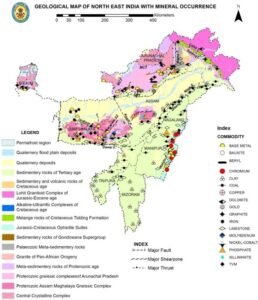 Map-3: Mineral Wealth of North East
Ref: https://www.ndtv.com/india-news/northeast-region-a-storehouse-of-critical-minerals-centre-seeks-to-unlock-it-8833907
Prospects of REE in India– India has approximately 7.23 Million Tonnes of rare earth elements oxide (REO) contained in 13.15 Million Tonnes monazite (a mineral of Thorium and Rare Earths) occurring in the coastal beach, Teri and red sand and inland alluvium in parts of Andhra Pradesh, Odisha, Tamil Nadu, Kerala, West Bengal, Jharkhand, Gujarat and Maharashtra, while another 1.29 MT REE are situated in hard rocks in parts of Gujarat and Rajasthan, the Parliament was informed recently.
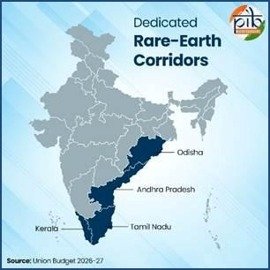 Map-4: Dedicated Rare Earth Corridor in India
Ref: https://www.pib.gov.in/PressNoteDetails.aspx?NoteId=157165&ModuleId=3®=3&lang=1
Efforts being Made to Explore and Process REE in India–
- In 2021-22 and 2022-23, GSI conducted reconnaissance surveys for rare earth elements (REEs) including neodymium in Sirohi and Bhilwara districts of Rajasthan. Additionally, the Department of Atomic Energy discovered around 1,11,845 tonnes of in-situ Rare Earth Elements Oxide (REO) in Balotra, Rajasthan.
- The Atomic Minerals Directorate for Exploration and Research (AMD), a GoI establishment, is tasked to do exploration and augmentation of REEs. They are presently mining along the coastal, inland and riverine placer sands as well as in hard rock terrains in several potential geological domains of the country.
- GSI has augmented 482.6 MT resources of REE ore at various cut-off grades in 34 exploration projects. The quantum of rare earth minerals exported during the last 10 years is 18 tonnes, while there have been no imports of rare earth minerals.
- MEA is engaging with relevant stakeholders to alleviate the challenges arising from export restrictions on rare earth magnets imposed by certain countries. There have been continued engagements at bilateral and multilateral level to increase cooperation in peaceful uses of rare earth minerals and related technologies, with objective to get prepared for disruptions, if any and if ever, in the supply chain.
- The Ministry of Mines has entered into bilateral agreements with the governments of a number of countries such as Australia, Argentina, Zambia, Peru, Zimbabwe, Mozambique, Malawi, Cote D’Ivoire and International organisations such as International Energy Agency (IEA), Dr Singh said. The Ministry is also engaging on various multilateral and bilateral platforms such as Minerals Security Partnership (MSP), the Indo-Pacific Economic Framework (IPEF), and initiative on Critical and Emerging Technologies (iCET) for strengthening the critical minerals value chain.
- The Ministry has initiated the process of entering into government-to-government (G2G) MoUs with Brazil and Dominican Republic for developing cooperation in the field of rare earth minerals and critical minerals. The broad objectives of these MoUs are to provide an overarching framework for cooperation in research, development and innovation in mining, with a particular focus on REE and critical minerals.
- In the Union budget presented on 01 Feb 2026, The GoI has proposed the establishment of dedicated rare earth corridors in Odisha, Andhra, Tamil Nadu and Kerala with the objective of expediting research, mining, processing and manufacturing of permanent magnets from REE available in these states. The initial budget allocated for this purpose is Rs 7280 Crores.
- Rare Earth Extraction and Processing Facility- IREL (India) Limited, a firm operating under the Department of Atomic Energy is running a Rare Earth Extraction Plant in Odisha with a capacity of capable of producing ~11,000–11,220 tons per annum of Rare Earth Chloride and 5,000 tons per annum of Rare Earth Oxide (REO) and a Rare Earth Refining Unit at Aluva in Kerala having a capacity of 4000 tons. It specializes in processing mixed rare earth chlorides and monazite to produce high-purity (>99%) individual rare earth oxides/compounds, including Lanthanum, Cerium, Neodymium-Praseodymium, Samarium, Gadolinium, and Yttrium. The GoI is aiming to expand domestic rare earth capacity, foster advanced manufacturing, and accelerate India’s transition toward self-reliance and clean energy.
- India joins Pax Silica on 20 Feb 2026.
What India Needs to Guard Against– Critical minerals like Lithium and neodymium are key to modern industry. The stranglehold of China on their supply is a matter of concern for every major economy. India’s recent pact with Brazil and engagement with the Forum on Resource Geostrategic Engagement (Pax Silica is a part of this initiative) are steps to tackle China’s monopoly on these minerals. India is working on two approaches. One, pushing on exploration, refining, recycling and recovery of these minerals. Second is forging alliance with other countries, MoU with Brazil on RRE and Critical minerals signed on 21 Feb is a step in that direction. However most important part in the entire cycle is separation/ refining technology, skilled labour to handle that, availability of specialised equipment. However, a word of caution! India needs to remain cognizant of time for the outcome, should, remain cognizant of cost of cycle and ensure that we do not fall in the trap of strategic dependence.
Crystal Gazing on New Strategies
Besides contingency planning mentioned earlier, following steps need to be taken by various stake holders:-
- Technological substitution and efficiency: Engineers/ researchers need to find ways and means to reduce heavy-REE content by going for finding , alternate materials, without sacrificing performance?
- Resilience by design: Concerned countries /Companies need to factor in building dual-sourcing or buffer stocks into their planning architectures.
- Geopolitical alliances: Expect more cooperation between U.S., EU, Japan, Australia, India — joint projects to pool capital and spread risk.
- Regulation & strategic minerals policy: More countries may follow China’s lead in classifying rare earths as strategic resources, enforcing export licensing.
- Sustainability & environmental constraints: Even as new mines open, environmental pushback and cost of processing will limit how fast they scale.
Conclusion
The recent showdown between China and the U.S. over REE isn’t just about minerals. It’s about control over the backbone of modern tech and defence. It not only affects US but others are impacted as much. India has to expedite research and development to either ensure ramping up of the domestic production of the critical minerals as well as REE or go for international tie ups. However in today’s geopolitical scenario where pursuing national interests is a strategy to exploit vulnerabilities of the adversaries and even friends, India needs to either create interdependence or ramp up indigenous production. It may be noted that these elements themselves are small, but their influence looms large especially based on their relevance creating a net zero polluting emissions as target announced at the 26th session of the United Nations Framework Convention on Climate Change (COP 26) in November, 2021, announced its target to achieve net zero by 2030. India has, however the target of 2070 CE achieving Net Zero Emissions. For countries/companies, policymakers, and investors in tech and infrastructure, the message is clear: mastering raw materials now matters as much as mastering algorithms. In this era, supply chain resilience and strategic foresight might be the edge that matters most.
End Notes:
 Author – Maj Gen AK Chaturvedi, AVSM, VSM (Retd) is a retired Indian Army General Officer who has served in Jammu & Kashmir, NE, Andman Nikobar on various appointments at Command and Army HQs. He is Chairman of Think Tank, “STRIVE India”, after retirement is pursuing his favorite hobby of writing for newspapers, journals, and think tanks.
Disclaimer: The views expressed are those of the author and do not necessarily represent the views of the organisation that he belongs to or of the STRIVE India.